
Periodically, I’m inviting friends and strangers who inspire me to share some things they’ve saved recently on their phones. I’m happy to have one of my very best friends Alec Sturgis kick off this guest edition of Things I Saved. Alec is a writer, musician, yoga instructor, and digital asset manager at an industrial supply company. Along with Nick James Scavo and Alexander Iadarola, Alec runs the music criticism collective 2020 Music Group, which you can find here on Substack. This past week, 2020 Music Group inaugurated their monthly column on Artforum where Alec wrote about digging the depths of Spotify for “outsider music.”
Without further ado… here’s what Alec has saved recently and what he has to say about it:
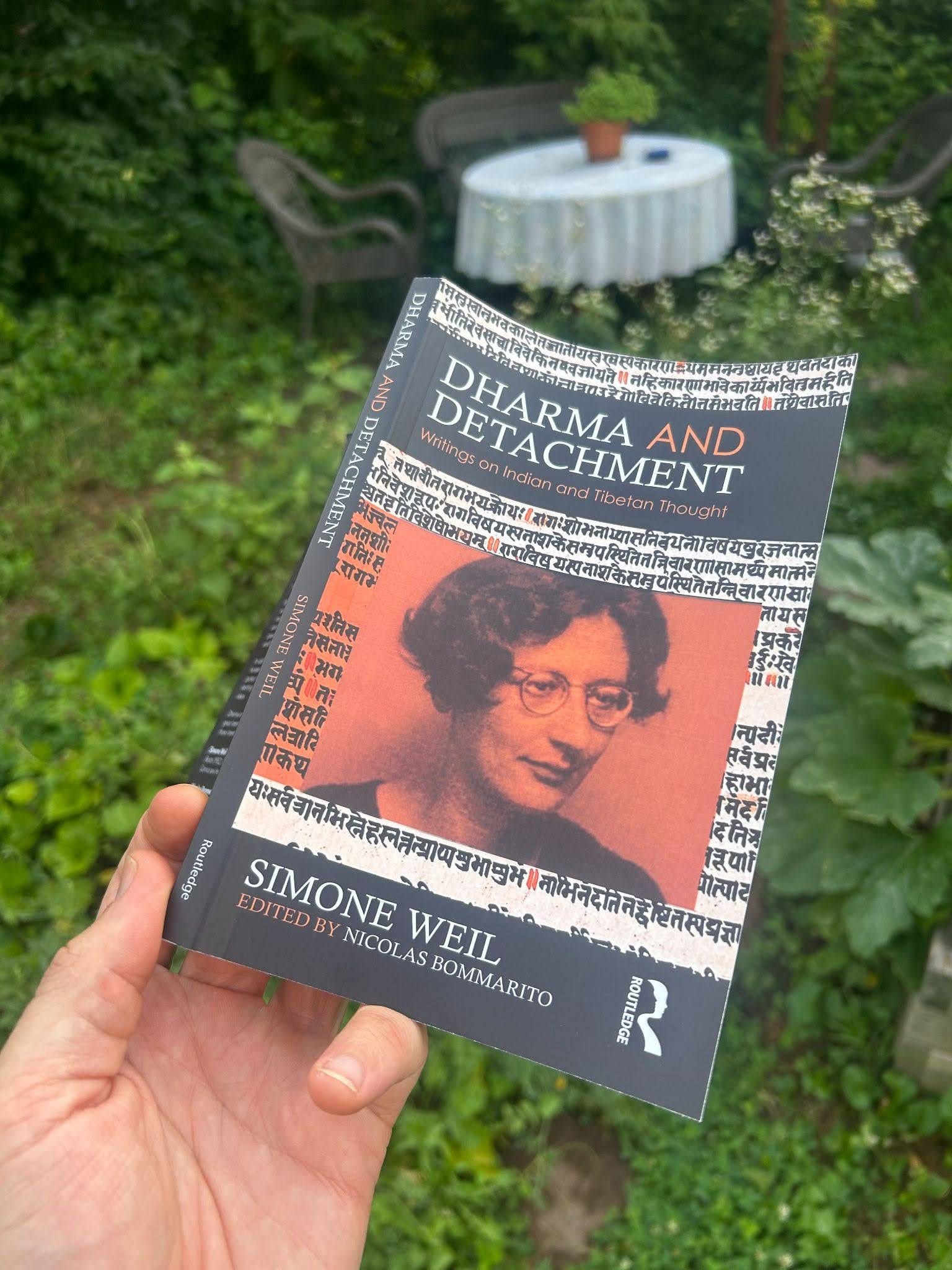
1) Some thoughts by Simone Weil, “The Gita,” Dharma and Detachment:
“Arjuna wanted to rise in the scale of good through an act. (In his case it was non-resistance). It is as though one were to seek to alter the balance of a pair of scales by shifting the pointer”
“All that he could do was, while remaining through and beyond his action in a state of contemplation, doubting its validity, standing outside it and straining towards the better and non-represented, to prepare himself to become later on capable of doing better. [...] Action is the pointer of the balance. One must not touch the pointer, but the weights. [...] Hence, “where lies the confusion? where the suffering?”

2) Maddie Ashman’s microtonal pop
I published a brief critical review of music by the young “microtonal pop” composer/performer Maddie Ashman a few weeks back on my Substack, 2020 Music Group. You can find that in full, here. My basic argument is that in spite of her high quality of work, performance, production, musicality, Ashman’s affectations around the physical properties of sound, and the systematic 20th century avant-garde associations with these questions project something like an apology for music’s basic lack of cogency as an expressive medium, and suggest that without high-conceptual intervention, the basic forms would fail to deliver. It’s not as if the exploration of alternate tonalities is unintuitive or out of place here, but this knee-jerk valuation of the affect of experimentation over the content and contexts which it produces suggest a deep anxiety in the creative psychology and a state of flight from the material and medium in-themselves into an ultimate, compressed state, whose aesthetic immanence is secondary to its historical, commercial and discursive location. Touching the pointer, without touching the weights.
3) Chick-Fil-A associate
Where lies the confusion? where the suffering?
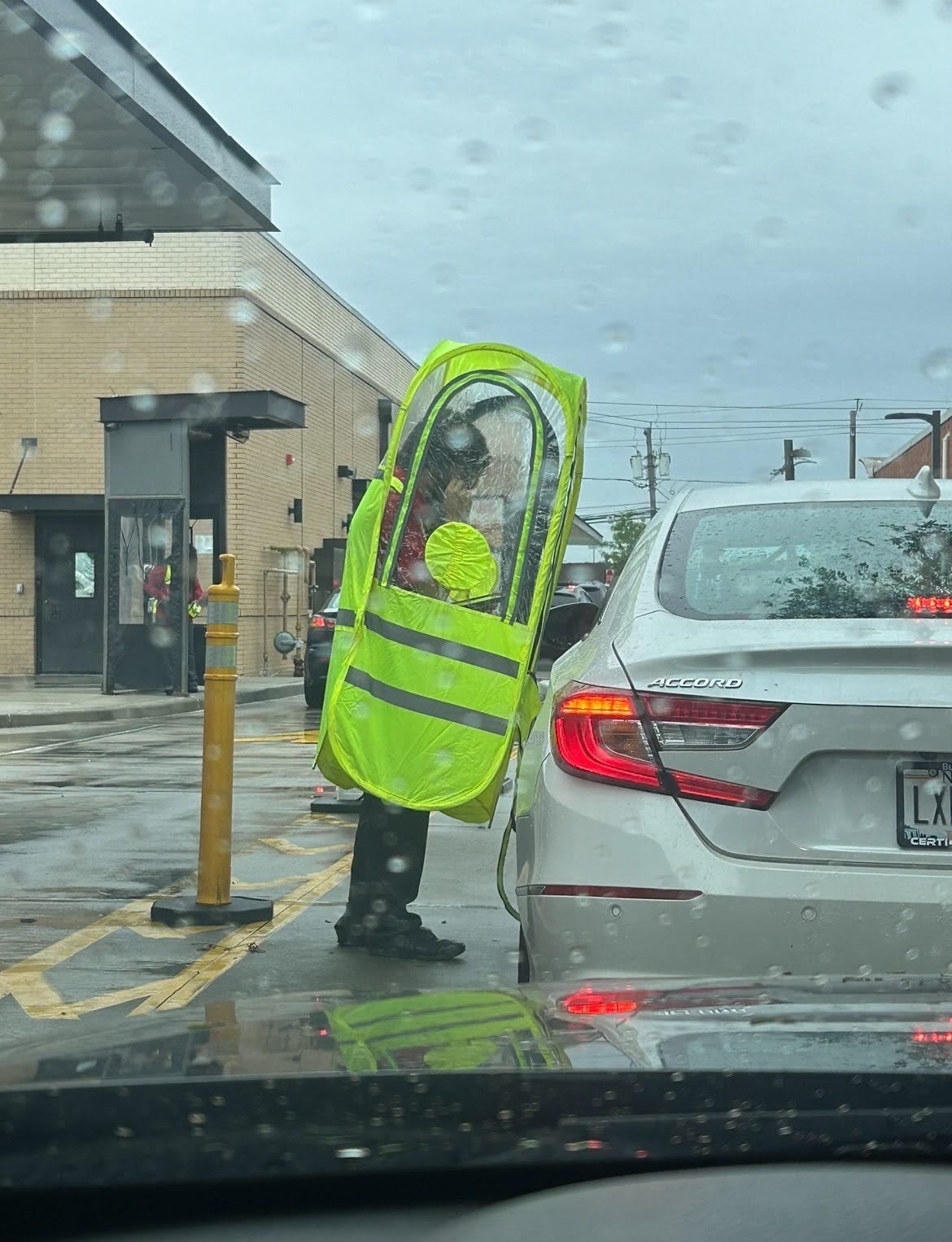
In the rainy drive-thru of Chick-Fil-A, young associates, carrying tablets, wear small, boxy, transparent tents affixed to their bodies in order to provide their customary service at the driver-side window. They have the top-heavy silhouette and bright-yellow color of minions, jeans extending from the low-hanging form, and what we may imagine are a concealed set of overalls within the terrarium.
We can see both confusion and suffering here. A confusion around this priority of the consistency in customer experience and how these measures to sustain it, in fact, might surface some revelation of a cultural contradiction. The suffering is, in that sense, also systematic: beyond the functional, yet humiliating, appearance of the rain-tent, the most valuable propositions (corporate localism, sincerity and personability of service) are cast into absurdity, creating a visual rupture in the communitarian illusion, turning local high school students into the faceless laborers of Despicable Me. A strategic consideration of the weights on the scale, only possible through a dissociation within the actions that produce its contradictory appearance, and from the “pointer” which reads so clearly.
Without belaboring the comparison, I feel there is an inverse sort of dissociative calculus found in Maddie Ashman’s “microtonal pop.” The rain-tent leaps from systematic consistency into destabilizing industrial poetics; Ashman imposes a superficial aesthetic rationale upon an already functional project and medium, insecure in its value.
One seeks primarily to address suffering (of delayed chicken sandwiches, of rain-drenched workers, of lost efficiency and brand consistency), and so articulates the internal incompatibility of its actions. The other addresses confusion (around the values and ethos of elite conceptual frameworks and the avant-garde, of the anxiously-attached, progressive pact behind historically informed creative production), and so obfuscates the most naturally elegant and coherent parts of its beauty.
In correspondence with Weil’s meditation on the Gita, Arjuna’s dilemma was no more or less institutional or personal in nature, no less commercial, moral or expressive.
4) Cowboy quote from the Longhorn Steakhouse bathroom
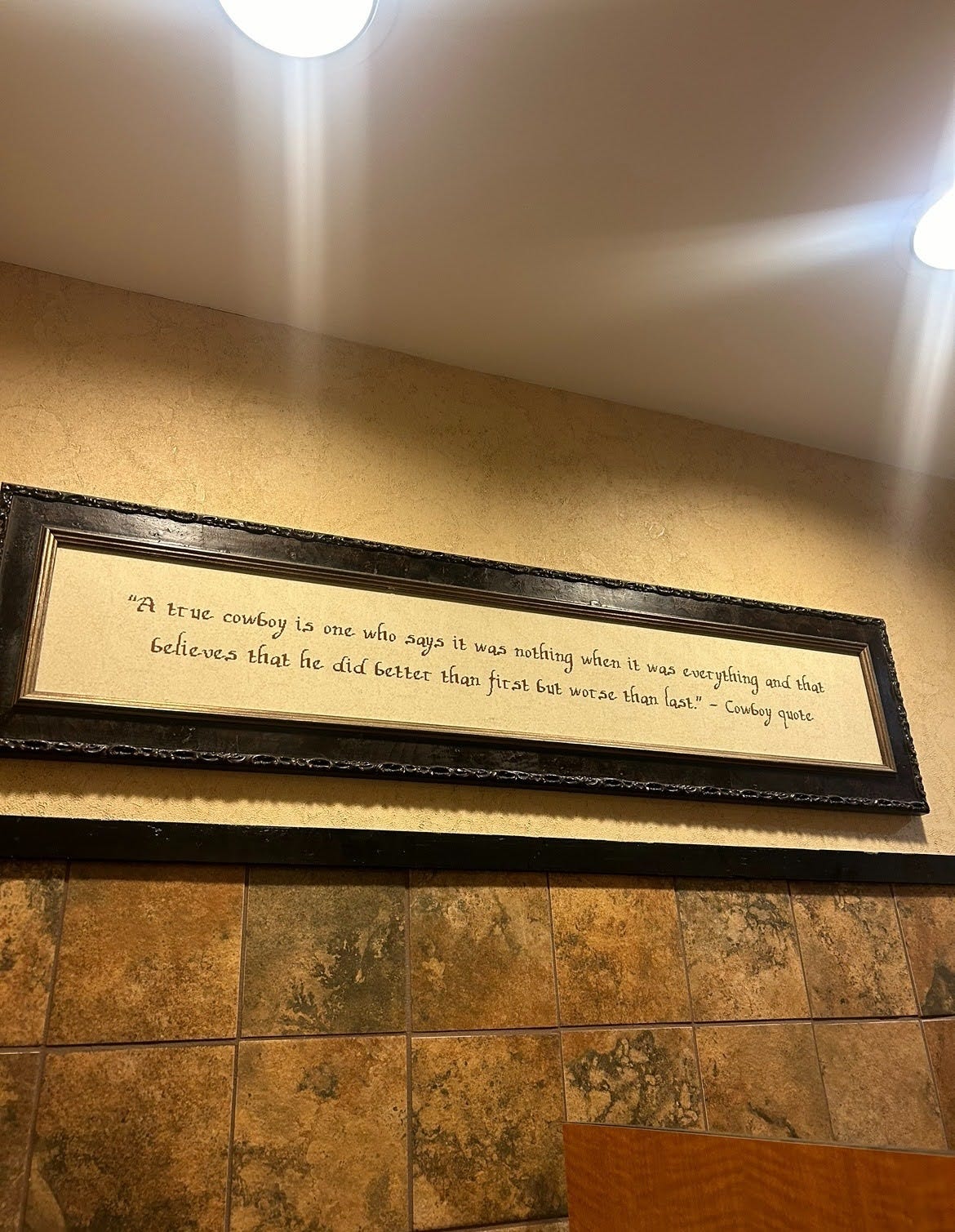
“A true cowboy is one who says it was nothing when it was everything and that believes that he did better than first but worse than last.”
I saw this on the bathroom wall at the Longhorn Steakhouse in Farmingdale, on Long Island. A bespoke painting within the inner sanctum of the franchise, where diners like myself seek a moment of relief and reflective quietude. The “true cowboy” invokes a deep-historical notion of serenity, integrity and noble humanity in perfect concert with labor, imbued with the romantic imagery of an industrial past in which mass production takes place under an open sky. It’s functional, yet humiliating to read this wise tautology while relieving myself in the midst of a competitively priced dinner. Deep down, I feel that. And yet, I also derive a charge of inspiration from the message, and - in its absurd appearance - it feels there could be no clearer or more luminous setting in which to receive and interpret it.
“It was nothing when it was everything,” is a strangely repressed and sadly egoistic suggestion that I resist from the imagined cowboy, yet simultaneously receive in its spirit of zen magnanimity. I imagine the quality of my steak is greater than the franchise that serves it to me. But standing at the urinal, there is no cowboy. Neither here nor there. And even if, for a moment, I allow the consideration that the cowboy is me and that the absurd reverie produced in me by this situation is in-and-of-itself, significant - “everything” and “better than first” in my recognition of it; I shift, “it is nothing.” I dismiss my inspiration and “doubt its validity.” Why?
This experience produces a thought that I should not have been there in the first place, and that the circumstances of my person, my attention, my reflexes of interpretation articulate the systematic limitations of my own ability to transcend confusion and suffering, as they locate me precisely in the state of confusion and suffering that is mine alone. I will forever be the poet laureate of the Longhorn bathroom and also far “worse” than every disinterested urinator who came before me.
Again, Weil comments on Arjuna: “All that he could do was, while remaining through and beyond his action in a state of contemplation [...] to prepare himself to become later on capable of doing better. How can I do better? “It was nothing, when it was everything.” I can argue with this, because it’s fairly stupid. But I’m certain that would not address the reason it concerns me.