

Welcome to Things I Saved. Each week I share some links along with my thoughts on the news, platform shifts, strange incentives, and emerging formats shaping the future of technology, entertainment and culture.
Good morning from 100 degree New York, New Jersey. This week: the U.S. government wants to decide who gets access to the best AI models, Gen Alpha wants to build its own apps, and AI shopping assistants might determine which consumer brands are popular.
Let’s get into it…
The U.S. government will decide who gets to use the latest American AI technology. AI models have gotten really good at doing useful stuff with computers. They’ve gotten so good that they’re able to improve themselves without human intervention—the AI labs call this recursive self improvement. This is great if you’re a scientist or a programmer. The smarter the model, the better and faster you are at running experiments and making software, right? Not so simple. As these models get smarter they are also getting better at doing bad stuff, namely making bioweapons and launching cyberattacks. Unsurprisingly the federal government doesn’t want laymen making bioweapons, so it’s limiting access to GPT 5.6 to a small group of 20 government-approved trusted partners. Meanwhile, open source models from Chinese companies like Z.ai are not far behind the frontier and are freely available and outside of US jurisdiction. How will this work? Will the US ban the use of open source models from China? Lots to watch here.
Consumer software is becoming wide open again. Josh Elman says this is mostly due to the increasing availability of really good open source and on-device AI models like the Chinese ones mentioned above. VC firms are betting the US government won’t ban open source models outright. Elman is a Silicon Valley vet who spent time at LinkedIn, Facebook, Twitter, Robinhood, among others. In his recent post on X announcing that he’d be joining the VC firm A16Z, he said, “We have a new wave of users, especially the newest cohort of gen-alpha consumers, that really want to make things. They are native world-builders themselves. They came up playing Roblox and Minecraft, they have no preconceived limitations about what an app is, or what they can do with it. They expect to be able to customize or build anything they want for themselves and with their friends. And now, suddenly, we’re there.”
I asked Claude, Gemini and ChatGPT to tell me what to buy 8,700 times. Deana Burke posted an interesting report on AI and product purchase recommendations. Burke found that all three major AI providers recommended the same clusters of products more often than expected even though they were each pulling from different sources. Also, they weren’t that likely to source product opinions from Reddit, surprising given how much attention Reddit gets for being one of the main knowledge sources for AI models. Burke summarizes: “Being the model-recommended brand is about to be one of the most valuable and least understood positions in commerce, and the data on how this is happening is so far pretty thin.”
Zero marginal cost yapping into your iPhone is ultracompetitive now and increasingly rare to see scale in 2026. Brandon Gorrell gave a great rundown on the state of independent media after a trip to Cannes Lions saying: “The end state here is not ‘everyone goes independent’ or ‘everything reconsolidates into traditional media’ - it’s more of a sorting process where some creators find elegant business models outside of large organizations, and others merely leverage the possibility of going independent into more meaningful contracts within traditional media organizations.”
The AI buildout is bottlenecked by energy. But America has the electricity to power its data centers; the problem is getting it to them. As I’ve covered previously, data centers have a popularity problem. That is to say, they are very unpopular. Public opposition to AI data centers now sits at 71%. But rest assured, data centers aren’t going anywhere and they’re going to continue to need more power than ever (for a good primer on why data centers are good see Packy McCormack’s recent essay on the topic). Market analyst in electric power Chris Gillett details this AI driven growth in the demand for power: “The data center boom has exposed the weakness of Western grids. But these are not the only new source of demand for electricity that we can expect in the coming years. Industrial electrification, hydrogen production, water desalination, heat pumps and air conditioning to cope with climate change, electric vehicles, and perhaps even electric aircraft are all likely to increase demand.”
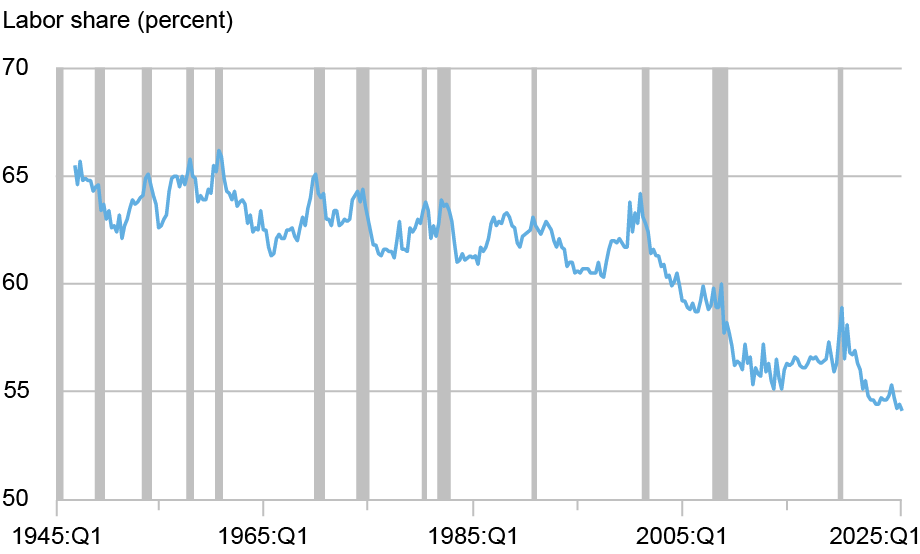
Productivity and prices are growing faster than wages. The US “labor share”, a commonly used metric in economics that “measures the fraction of economic output paid to workers as wages and salaries” is at an all-time low since prior to WWII. Liberty Street Economics looked at recent data and concluded that “these results suggest that the post-COVID decline follows the same cyclical patterns as earlier recessions and is driven by the same within-industry forces, and they provide little evidence that it will evolve differently from past episodes.” How does AI change this? Clearly a “metric to watch” in the coming years.
Images I Saved






romanian mentioned 🦅🇷🇴🇷🇴🇷🇴🇷🇴🇷🇴🇷🇴🇷🇴