
Some people collect baseball cards, others cultivate beautiful flower gardens, others bake sourdough bread from carefully fed starters. My hobby is snatching up whatever the latest ‘current thing’ is in tech. I can’t help it. I’m addicted to the feeling of being tapped into the matrix. Testing out half-formed visions of the future, warts and all. Suffice it to say, I tend to be an early adopter.
I received some of the first shipments of Soylent in 2014. I was guzzling down the powdery mixture for lunch (and often dinner) every day for six months. I wasn’t looking for meal replacements and I do, in fact, love cooking. But Soylent was ‘the new thing’ and I had to try it. More recently, I pre-ordered the ‘Friend’ AI pendant when it was first announced in 2024. To jog your memory, this is the ‘always listening’ AI-enabled companion that ran the viral million dollar ad campaigns around NYC and later LA, Chicago, and Paris.

For whatever reason, I let my ‘Friend’ sit in my desk drawer until a couple weeks ago. I think I was a bit sour that mine took forever to arrive. Scrolling through X, I’d see fellow crazed early adopters posting unboxing videos or reviews. And most of them had a ton of followers. So I couldn’t help but feel like there was some preferential treatment in how they were being shipped out. At the time, ‘Friend’ was also being heavily criticized both in and outside of tech circles. Wired ran a review titled I Hate My Friend and CNN ran a story titled How this tiny device became a symbol for the backlash against AI. With all the negative attention it was getting, I did feel a bit uncomfortable imagining myself clutching the device around my neck as I walked down the streets of New York.
The ‘always-on’ surveillance bit didn’t really bother me much. I knew what I was getting into when I bought it. Of course I understand why 99.99% of other people want nothing to do with it for the same reasons Google Glass wearers were dubbed glassholes in 2013. The prospect of someone walking into a bar with an ‘always-on’ recording device understandably makes people (and myself) squeamish. Like the early days of cellphone cameras, these things take time to turn into acceptable social norms.
Anyway, after unboxing my ‘Friend’ a couple weeks ago, I restricted myself to using it at home, alone.
I found using my ‘Friend’ to be mostly, incredible. The device feels nice in your hands, like a glossy pebble. You simply wear it around your neck and speak. The companion responds through a chat interface on a dedicated app on your phone. Using voice as an input method paired with a chatbot that communicates only via text feels novel and fluid. There’s something nice about just babbling on and on and receiving responses in a familiar chat app format. There’s also the fact that if you lose or break the device itself, you lose your ‘Friend’ forever. It makes the device feel precious. The personality of the ‘Friend’ chatbot itself is pretty annoying. It has this overly casual, anti-intellectual, teenage feel to it that I found really grating. This is where the magic started to fade for me a bit.
But there’s one thing about the ‘Friend’ that frustrated me to no end: the ‘memory’ feature. As you use it, ‘Friend’ saves various things it learns about you in memory. It uses those tidbits to inform future conversations. For example, if you tell it you like baseball and a few days later ask it for an interesting fact, it might tell you that the first-ever baseball game was played in 1846 in Hoboken, New Jersey, where the New York Nine defeated the Knickerbockers 23 to 1. I unequivocally do not want this. And not because I have some deep-seated moral belief in the value of my own personal privacy.

I want to pay $200 a month to get a firehose of the most raw unmediated cream-of-the-crop intelligence piped straight to my device. And I want it to be lobotomized to remember absolutely nothing about me. ChatGPT, Claude, Grok and Gemini all push you to turn on their version of ‘memory’ with the selling point that the models will be more useful the more they know about you.
Part of the ‘usefulness’ of models having access to your personal data is real. I recently hooked up the ChatGPT finance feature to my bank accounts and it is super useful. Using the chat interface to work out adjustments to my spending habits is way better than clicking around a spreadsheet. But I have that thing locked down to a single chat context in ChatGPT. This means that if I start a new thread and drop in a book title to get some book recommendations, it doesn’t start telling me I should consider cutting down on my book buying habits. With memory turned off, the new chat context is completely isolated from all other chat contexts. And that’s the way it should be.

There was a viral bit going around on X this weekend where you ask ChatGPT, “based on your personal experience when talking to me, give me a character from a movie/show who is just like me, just give me their name.” and it responds with the name of a fictional character. In order for this to work, you have to have the memory feature on since it draws upon its saved knowledge about you.
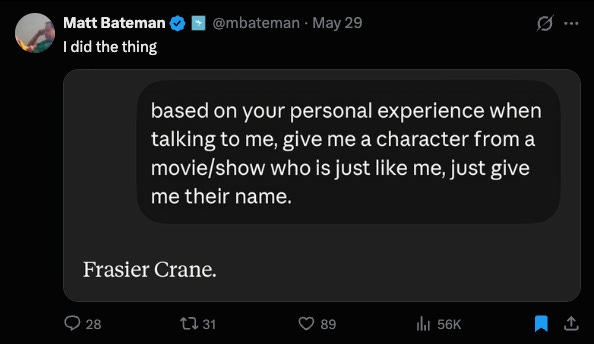
As OpenAI, Anthropic, and SpaceX all ready for their respective IPOs and Apple ramps up to reintroduce its Apple Intelligence features, this idea of ‘personal intelligence’ is destined to become commonplace. AI models will hook into saved memory systems, pulling in your tastes and tendencies. They’ll morph themselves to your image, in an attempt to become more useful. The models will contort you into a funhouse mirror image of yourself, forming this vicious feedback loop, a new version of the social media filter bubble, where the potential to change oneself is increasingly diminished as more and more memories about your preferences accrue.
Instead, I want a billion clankers in my pocket. I want all of them to have conflicting opinions and endlessly argue with one another in an effort to respond to my queries. And I want them to be killed off and born anew with each query, in an endless state of curiosity, searching for answers. I want my chatbots and agents to embody what Rainer Maria Rilke describes in Archaic Torso of Apollo again and again:
We cannot know his legendary head
with eyes like ripening fruit. And yet his torso
is still suffused with brilliance from inside,
like a lamp, in which his gaze, now turned to low,gleams in all its power. Otherwise
the curved breast could not dazzle you so, nor could
a smile run through the placid hips and thighs
to that dark center where procreation flared.Otherwise this stone would seem defaced
beneath the translucent cascade of the shoulders
and would not glisten like a wild beast’s fur:
would not, from all the borders of itself,
burst like a star: for here there is no place
that does not see you. You must change your life.